
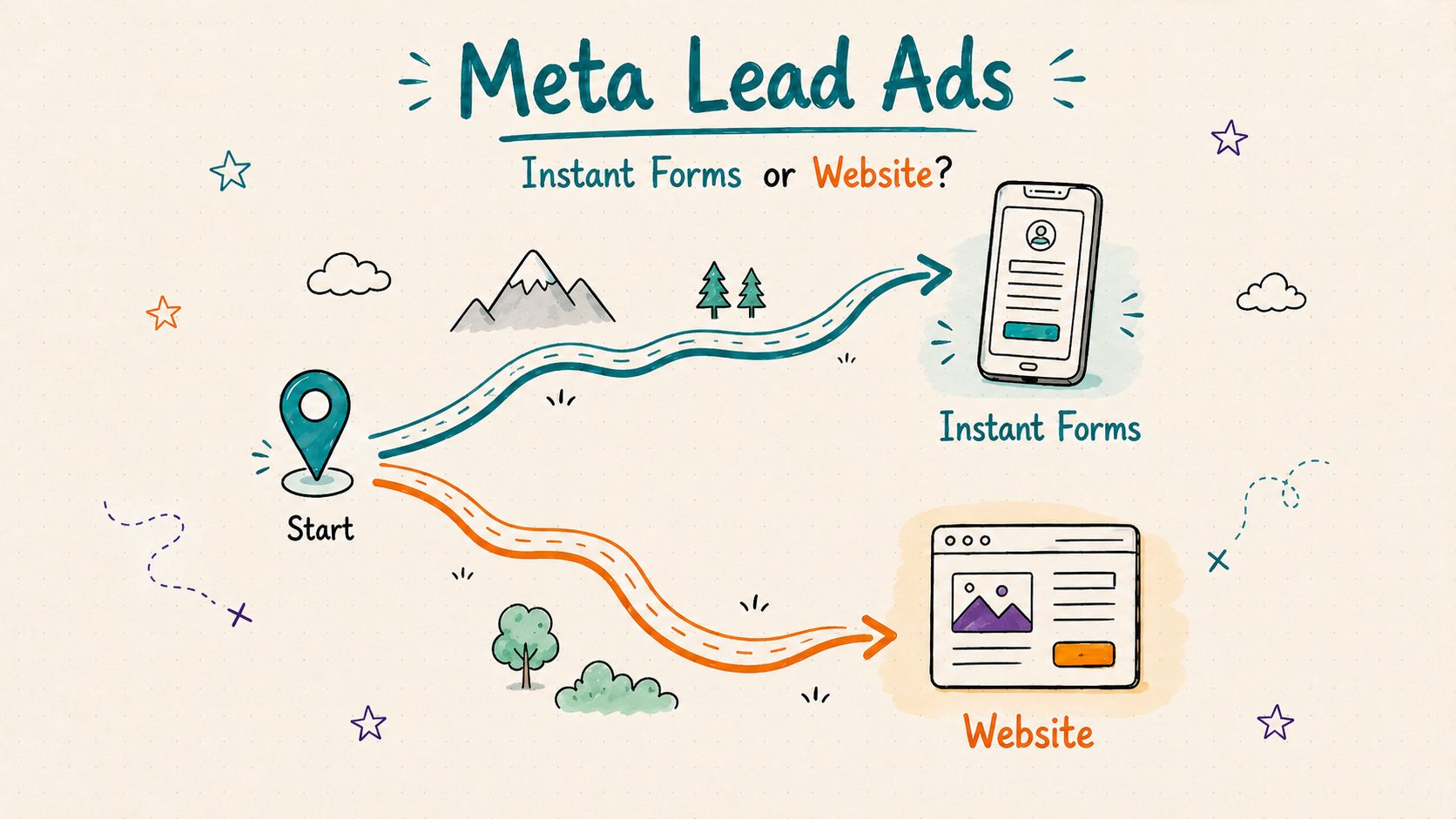
If you’re a course creator, coach or community builder using Meta lead ads for list-building, launching or community growth, there are two conversion locations worth understanding for more scalable lead generation:
- Instant Forms
- Website
In this article, I want to explore the key differences between the two and why they matter.
Because it’s probably not what you think.
What are they?
1. Instant Forms
A mobile-first, in-app form on Facebook or Instagram that captures a prospective new lead’s details.
No website or funnel pages needed, besides a link to your Privacy Policy.
Which means not having to worry about:
❌ mobile optimisation
❌ page load speeds
❌ conversion rate optimisation
❌ compliance
❌ Pixel, CAPI and event setup
❌ attribution or reporting errors
The user doesn’t suffer any delay waiting for pages to load, and Meta will usually autofill their details.
Instant Forms are often described as a low-friction lead capture route.
From a setup point of view, Meta lead ads are one of the fastest and simplest ways to get started with Meta conversion ads.
This makes them especially useful for early-stage businesses, founders newer to Meta ads, or community builders without a website, such as those growing on platforms like Skool.
They’re commonly used for:
- lead magnets
- offer validation
- list-building
- free community growth
- waitlists
But they’re not only for newer businesses.
Instant Forms can also support evergreen list-building strategies for more established businesses, AKA your Lead Engine.
Instant Forms are often criticised for attracting low-quality leads, partly because the forms are so easy to complete.
That criticism isn’t unfounded, but it is too simplistic.
The offer, ad copy, creative, form questions, form setup, campaign setup and performance goal all influence the quality of leads generated.
In truth, Lead ads in any conversion location have the potential to attract poor-fit or low-quality leads.
With Instant Forms, you have to be especially intentional about how you set them up, filter, and judge success beyond just Cost per Lead.
Used strategically, Meta lead ads can be one of the most effective ways to ensure you have a constant supply of fresh, nurtured leads, which is the foundation of any successful and sustainable online business.
In the right circumstances, I firmly believe businesses that master evergreen lead generation with Meta’s Instant Forms early on are giving themselves a serious advantage.
2. Website
A website conversion location sends prospective leads directly from an ad (available in all placements) to a custom landing page.
This page could be a:
- lead magnet
- webinar registration
- offer validation
- waitlist
- quiz
- call booking or application
- Skool about page
In this instance, the prospect has to leave Meta, wait for the page to load and read it before deciding whether to complete the form.
That creates more friction, which typically results in a higher cost per lead.
Higher friction is commonly cited as an important factor in increasing lead quality.
The theory is that only those with greater intent to access the offer will complete the process.
But that’s only one part of the equation.
If an offer needs more explanation, more trust needs to be established, or a prospect needs to better understand the value – a full landing page can provide that added texture in the way an Instant Form cannot.
This includes:
- branding, design, layout and flow
- richer storytelling, longer-form sales messaging, video, testimonials, social proof and clearer positioning around the offer
- more space to demonstrate expertise and authority before asking someone to take the next step
- advanced forms, lead filtering, deadlines and time-sensitive launch messaging
Website conversion campaigns can also be optimised for specific events, such as booked calls. Or you can easily switch them from the lead to the sales objective if wanting to optimise for a backend paid offer.
In other words, the website conversion location isn’t necessarily the “better quality” route.
It is the route with more space, context, flexibility and control.
But that is only useful if the page is doing its job.
A slow page, unclear message, weak mobile experience, poor tracking setup or low conversion volume can all weaken performance.
✅ Done well, the landing page is doing valuable education, filtering and pre-qualification work.
❌ Done poorly, it adds delay, distraction, confusion and dropout.
Advanced Campaign Setup
There’s also another layer to this conversation around what Meta can optimise for beyond maximum volume of leads.
With the more advanced CAPI CRM setup, both Instant Forms and Website campaigns sending enough downstream actions back to Meta (such as booked calls or applications) can optimise for these higher-quality events.
These campaigns are likely to reduce your Cost per Quality Lead.
Summary
Meta’s Instant Forms are simpler, faster to set up, usually cheaper to run, and can be a highly effective route for long-term list-building, offer validation and community growth when the form, offer, creative, campaign setup and success metrics are handled properly.
Website lead campaigns give you more space, context, flexibility and control around the opt-in journey. But they also ask more of your funnel, tracking, budget and conversion volume.
Neither route wins by default.
The best choice is the one that fits your goal, budget, funnel, systems and experience level, whilst ensuring Meta is getting the right data signals.
Want help with your list, launch or community-building ads on Meta?
Check out my services here.